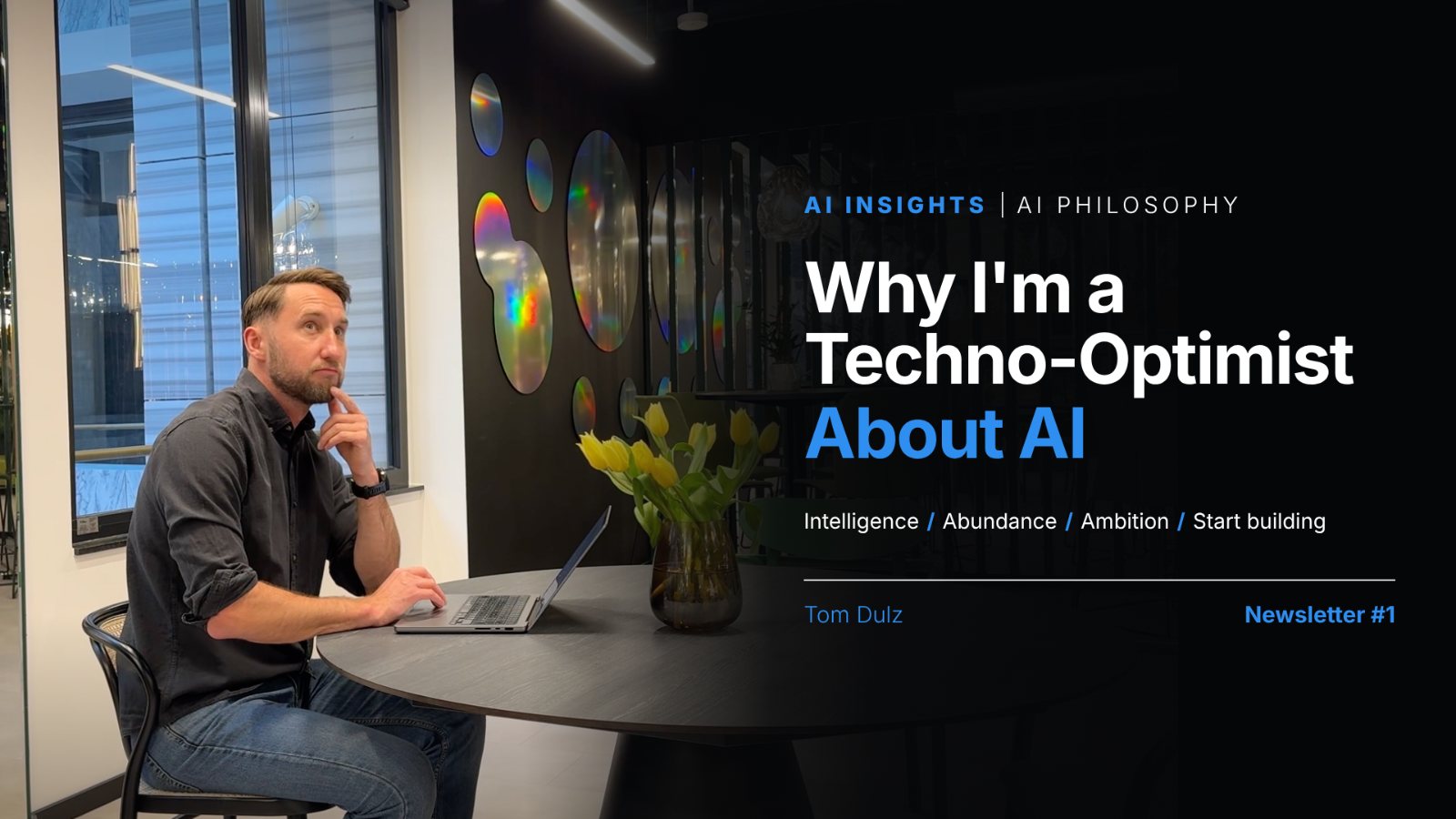
Why I'm a Techno-Optimist About AI
When people think about AI, they usually think about the next trick or prompt tip they can use.
It's also common to look for case studies of how someone used AI to work faster, do more, or do things they simply couldn't do before. A few of my favourites:
- Faster. Novo Nordisk uses Claude to produce clinical study documentation. According to Anthropic, the time needed went from more than 10 weeks to 10 minutes1.
- More. Duolingo launched 148 new language courses built with generative AI in under a year. As CEO Luis von Ahn put it, its first 100 courses took about 12 years2.
- Never possible before. Every, led by Dan Shipper, runs a daily newsletter, five software products and a consulting arm with about 15 people, and AI agents write virtually all of its code3.
Far fewer people think about their AI strategy. What do they really need AI for? What should AI do, and what should stay with people? Anthropic's AI Fluency framework answers this well, with its 4Ds: Delegation, Description, Discernment and Diligence4. I covered it in my video AI Fluency: The Framework Behind Getting AI Actually Right5.
And then there is the question almost nobody discusses. Why do we have AI at all? What is its nature? What is it, beyond the hardware and software that run it?
It's not a trending topic, to say the least. Still, I think it's worth thinking a bit about the philosophy of AI and asking a few harder questions. So let's do that here.
My lens is The Techno-Optimist Manifesto by Marc Andreessen, co-founder of Andreessen Horowitz (a16z)6. It states that technology is the single most impactful force that has pushed humanity forward. It's a bold text. Some say too bold. Still, I think it's exactly the mindset we need in the AI era.
So what does the techno-optimist approach really cover?
Intelligence
Think about the technology we have created as humans.
From our earliest tools, simple hunting spears and clay pots, to harnessing fire for warmth, safety and cooking. Then farming and the printing press. Sailing ships, railroads, highways and jet aircraft. And finally space rockets, computers and the internet.
All of it is technology. And all of it comes from our intelligence, which seems to be the main thing that sets humans apart from every other species on Earth.
The manifesto says it simply: "We believe intelligence is the ultimate engine of progress." And: "Intelligence makes everything better."6
Abundance
History is full of technological breakthroughs. Still, until the 19th century, you could argue that an ordinary person's life in 1000 BC and in Columbus's time was much the same: a short life, poverty and a constant risk of hunger. Everything humans did at scale needed muscle power, our own or that of the animals we used.
Then came the steam engine. For the first time, we could automate and multiply muscle power. Living standards, health and life expectancy took off. At the start of the 19th century, no country in the world had a life expectancy above 40 years. Today the global average is above 707. And these benefits reached whole societies, not only a narrow elite as before.
A similar revolution came in the second half of the 20th century. The transistor, the integrated circuit and the microprocessor led to the personal computer. Steve Jobs called the computer "a bicycle for our minds", and that's exactly what it became. A new era of information work began. At the same time, the internet connected humanity in a way never seen before.
All of this created enormous abundance and wealth. Over the last 250 years, humanity could, at scale, stop fighting for survival and start chasing bigger goals: beating diseases, building new social systems (democracy, a broad middle class, free market economies that give more people a fair chance), and reaching places that were unthinkable before: under the sea, the skies and space.
An era of abundance, where we could take on what used to be beyond our imagination.
New challenges, same approach
Of course, not everything went perfectly. Still, society as a whole benefited enormously. And this is one of the main ideas of techno-optimism.
New technology solves many problems and creates more wealth. It also creates new problems we didn't have before. Then we use technology to solve those problems, and the loop repeats. Again and again.
Railroads gave us fast transport, but on fixed tracks. So we built cars: flexible and affordable for ordinary people. Then we needed speed, so we built highways. Then came pollution, so we developed cleaner energy and, later, electric cars.
A loop that is never perfect, but always better.
Andreessen puts it like this: "Give us a real world problem, and we can invent technology that will solve it."6
Connecting humanity
When we focus on technology, we collaborate. Technology speaks universal languages: mathematics, physics, business and many more that cross borders.
Your country of origin and your culture don't matter, as long as you build new tech, work with others and ship it through the global market economy. Andreessen calls markets "the ultimate infinite game"6. (Infinite games deserve their own edition. Coming soon.)
That's what connects people despite their differences. It's the opposite of power games that create conflict and friction.
Building new tech is what pushes humanity forward. And every one of us can pick this challange.
Ambition
At the core of techno-optimism sits ambition. "Technology is the glory of human ambition and achievement," writes Andreessen6.
When we look back, through all the challenges and setbacks, we see humanity moving forward. It's not an easy path, but it's one we can be proud of. That gives us confidence that more technological progress is not only possible and necessary, but truly valuable for all of us.
In the 1950s, the internet in every home sounded like magic. So did smartphones, self-driving cars and societies organising themselves through social media. The idea of AI already existed, but no ordinary person would have believed what AI can do today. Magic, to say the least.
So think about what could be possible in the next 50 years. The stars are waiting, and much more.
Be ambitious.
What it all means for AI
Of course, we need to be mindful of the challenges and manage risks as they appear. Critics say the manifesto underplays them, and that's a fair debate. Techno-optimists treat those risks as new problems that further technology can solve. History has proved that again and again.
The steam engine automated our muscle power. The PC became a bicycle for our minds. So what is AI?
Look at the history above. Almost every advance solved one specific problem we had. AI is unprecedented because it is problem-solving capacity itself. Something we never thought we would have. Andreessen calls it "our alchemy, our Philosopher's Stone"6.
Today we can tap into the world's knowledge and get a solution for our very specific problem. With one prompt. Even more important, we can add to that knowledge faster and more easily than ever before.
Work that needed our manual effort can now be done by AI, and that trend is accelerating. Every past wave of technology brought the same kind of friction. But at its core, it always freed up human capacity for more ambitious work.
That's what we should do now as well.
What challenge can you take on now that wasn't possible for you before? What new tech can you build thanks to AI?
Think about it. And then... start building!
This is the first edition of Beyond Tactics, my newsletter. A new edition every Tuesday. Subscribe so you don't miss the next one, and tell me in the comments: what will you build with AI that you couldn't before?
Google Tom Dulz for more info on what I do and how we can work together!
- Anthropic, "Novo Nordisk accelerates clinical documentation and drug development with Claude", customer story. https://claude.com/customers/novo-nordisk
- Duolingo, "Duolingo Launches 148 New Language Courses", press release, April 30, 2025. https://investors.duolingo.com/news-releases/news-release-details/duolingo-launches-148-new-language-courses
- Lenny Rachitsky, "Inside Every: 5 products, 7-figure revenue, 100% AI-written code", interview with Dan Shipper, Lenny's Newsletter, July 17, 2025. https://www.lennysnewsletter.com/p/inside-every-dan-shipper
- Anthropic Academy, "AI Fluency: Framework & Foundations" course. https://anthropic.skilljar.com/ai-fluency-framework-foundations
- Tom Dulz, "AI Fluency: The Framework Behind Getting AI Actually Right", YouTube. https://www.youtube.com/watch?v=IPx2TycmPgo
- Marc Andreessen, "The Techno-Optimist Manifesto", Andreessen Horowitz, October 16, 2023. https://a16z.com/the-techno-optimist-manifesto/
- Max Roser, "Life expectancy globally", Our World in Data, October 8, 2018. https://ourworldindata.org/life-expectancy-globally