Respect Others' Cognitive Load
A few weeks ago, I wrote that you can go 10x faster with AI, but only as fast as you can verify. The limit isn't the AI. It's you: your time and your ability to read, review and check what was produced.
This edition is the next step. The same limit applies to everyone you send work to.
With AI, you can produce 20 times more. Long messages, detailed reports, Jira tickets, 40-slide decks. But if you expect other people to read all of it, it simply won't happen. Their cognitive load has limits too.
Long is easy, short is hard
Today, writing a long, detailed overview with AI is not a problem. It can be full of checked facts, sources, good points and tactics.
The real challenge is the opposite: making it short enough to be meaningful and easy to digest. Whoever your audience is: thousands of newsletter readers, your team, or one person you're asking for a review or an action.
This is one of the biggest skills in working with AI today: understanding your audience and keeping things short. AI tempts us to write too much, in too much detail.
And it's not a new problem. Back in the 1650s, the French mathematician and philosopher Blaise Pascal ended one of his Provincial Letters with an apology: "I have made this one longer only because I did not have the leisure to make it shorter."1
Writing long has always been the easy, lazy option. Writing short takes time and thinking. AI just made long free.
The curse of knowledge
There's a second trap. The author has the full context, so under time pressure it's hard to see what's missing. Now think how hard it is for the person receiving it.
Psychologists call this the curse of knowledge. In 1990, Stanford graduate student Elizabeth Newton asked people to tap out the rhythm of well-known songs, like "Happy Birthday", on a table, while a listener tried to guess the song. Tappers predicted listeners would get half of them right. Listeners guessed 3 songs out of 120, just 2.5%.2
The tapper hears the melody in their head. The listener hears only knocks on a table.
It's the same with your AI-generated update. You know every call and meeting behind it, so it all makes sense to you. The recipient gets a wall of text without the melody. A lot gets lost in translation.
The project update
Say you're a project manager or a leader coordinating an initiative: a new software implementation, a new market or a product launch. There are client calls and internal meetings, and you want everyone up to speed.
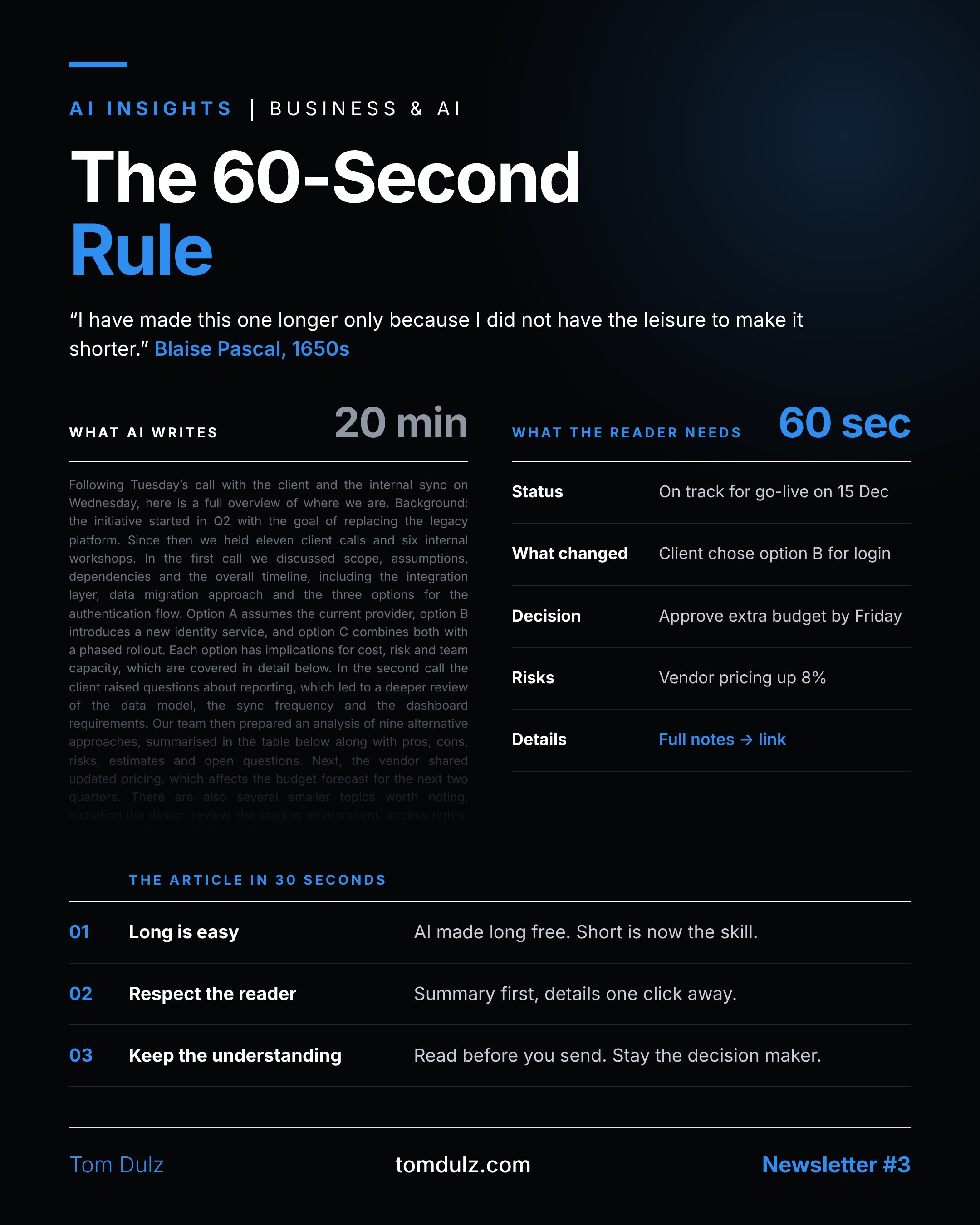
The temptation is to send a long update that covers everything. But nobody will spend 20 minutes reading through the nitty-gritty.
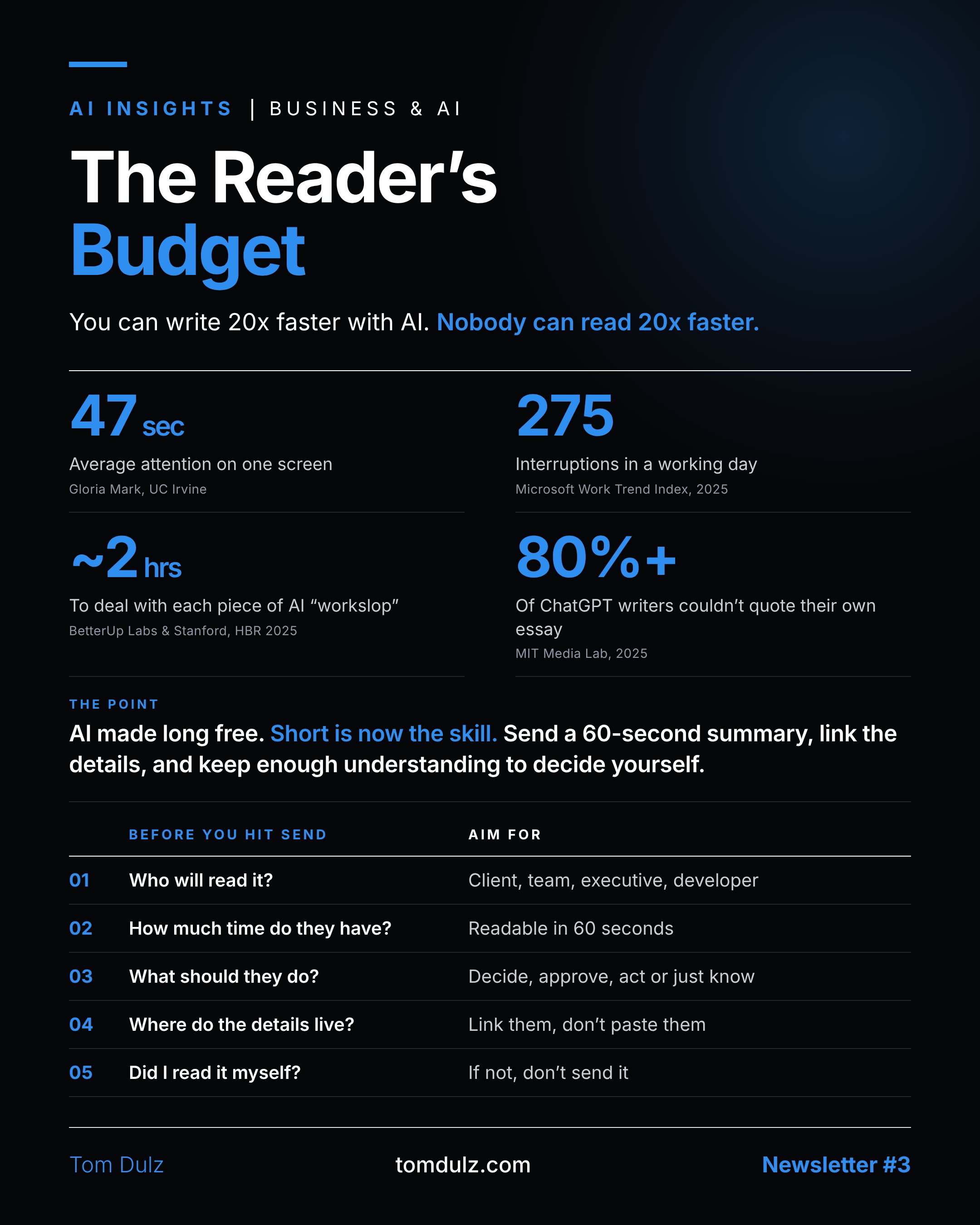
And your update is not the only thing they read that day. Microsoft's 2025 Work Trend Index found that the average worker gets 117 emails and 153 Teams messages a day, and is interrupted about every 2 minutes, around 275 times a day.3
The better alternative: a short overview that gives everyone the key information within 60 seconds, with a link to the detailed version for anyone who wants more.
Why 60 seconds? Because that's close to how people actually read today. Gloria Mark, a professor at UC Irvine who researches attention, found that people now stay on one screen for about 47 seconds on average, down from about two and a half minutes in 2004.4
This idea isn't new either. On 9 August 1940, in the middle of the war, Winston Churchill sent a memo titled "Brevity" to his War Cabinet. It opens: "To do our work, we all have to read a mass of papers. Nearly all of them are far too long."5
He asked for the main points in short, crisp paragraphs, with detailed analysis and statistics moved to an appendix. A short summary up front, details for those who need them. The same approach, 86 years ago.
- Avoid: a long, overly detailed update that covers everything.
- Foster: a short, executive-summary-style update with a link to the details.
Delegating with AI
Now say you want to delegate a task to someone on your team. You ask AI to analyse it and define exactly what should be done. The result is long, so you don't read it properly, and you send it anyway.
You know at a high level what you meant. You don't know whether AI got it right.
And you've fallen into the trap at the core of this article: you're ignoring the other person's cognitive load. They get an overly detailed brief that takes ages to read. If they find mistakes, the author often says: "Sorry, that was Claude or ChatGPT, not me."
There's now a name for this: workslop. Researchers from BetterUp Labs and the Stanford Social Media Lab, writing in Harvard Business Review in September 2025, define it as AI-generated work that looks like good work but lacks the substance to move a task forward.6
In their survey of 1,150 US full-time workers, people estimated that 15.4% of the content they receive is workslop. Each case takes nearly two hours to deal with, around $186 per employee per month. About half of recipients see the sender as less capable or reliable, and 42% trust them less.
So "that was ChatGPT, not me" doesn't work. Your name is on it, and so is the damage to trust.
The same trap, everywhere
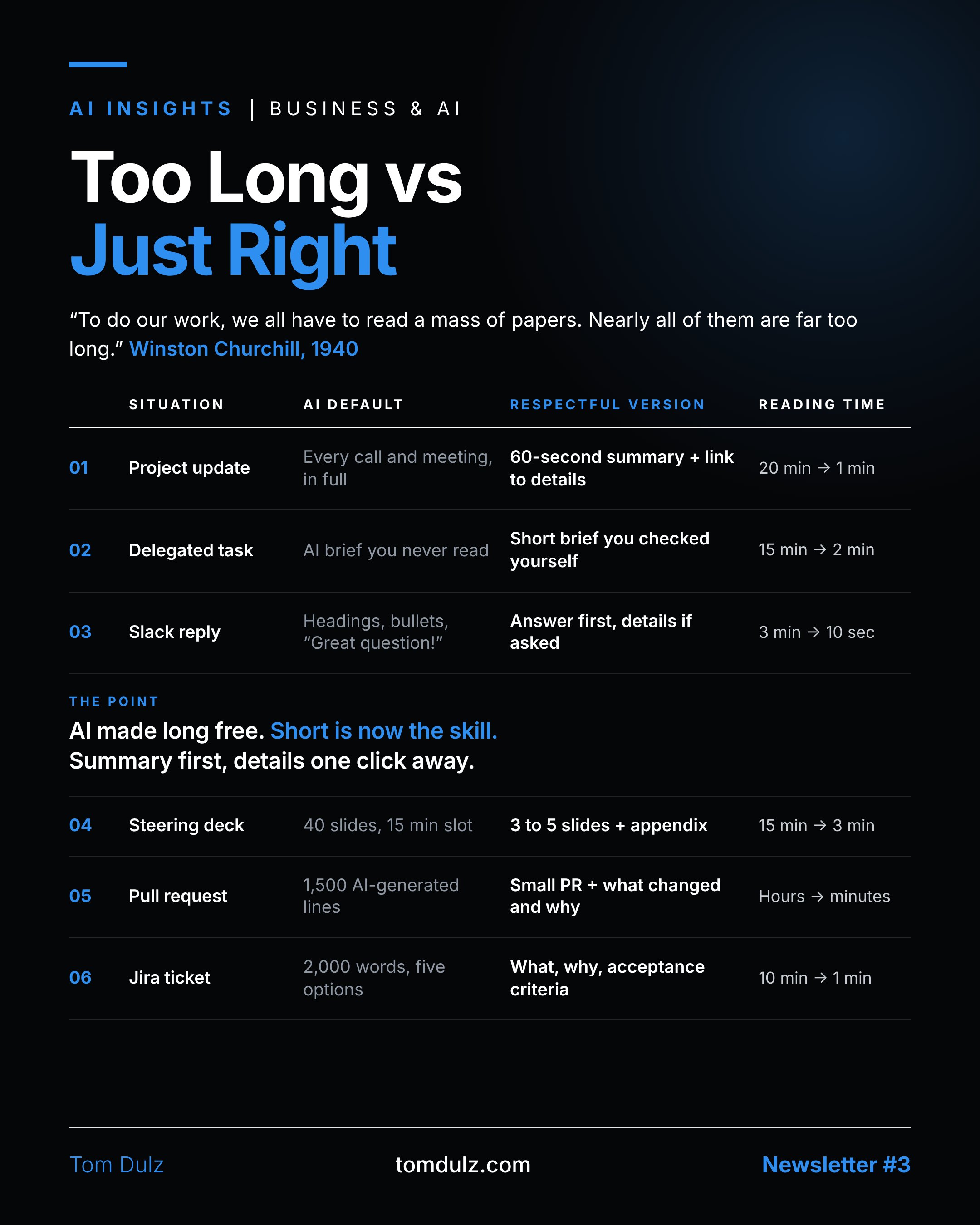
- The Slack reply. Someone asks a simple yes or no question. The answer comes back with headings, bullet points and "Great question!". Answer first. Add details only if asked.
- The steering deck. A 40-slide AI deck for a 15-minute steering meeting. Better: 3 to 5 slides with status, decisions needed and risks. The rest goes in the appendix.
- The AI pull request. A 1,500-line AI-generated pull request lands on a reviewer's desk. That's the verification limit, pushed onto someone else. Keep pull requests small, with a short note on what changed and why.
Tell AI who the reader is
The fix is simple, and AI can help. When you ask AI to write something for another person, tell it:
- Who will read it: a client, your team, an executive, a developer.
- How much time they have: "readable in 60 seconds".
- What you want them to do: decide, approve, act, or just be aware.
- Where the details live, so it links to them instead of pasting them in.
Then read it yourself before you send it. If you didn't read it, don't send it.
When AI talks to AI
Of course, when someone sends you a wall of text, you can use AI to process it. Many people do this well.
The risk is that your AI ends up talking to their AI, and everything gets more and more abstract.
I've been there. I asked the owner of a topic a fairly simple question. The answer: "I don't know. I need my AI to analyse it, because your question was generated by your AI." I explained that I wrote it myself, understood the topic and just needed a basic answer. They still needed time with their AI.
That's the risk: we drift into abstraction and give away the understanding of our own core work.
The golden standard of minimum understanding
This is why I want to introduce a concept: the golden standard of minimum understanding.
It's the level of understanding that lets us make decisions, and that we can't hand over to AI. It means we're comfortable with a topic and don't need to rush to AI every time someone asks a question. As long as we keep it, we're the decision makers and AI is a tool that helps us.
There's early evidence of what happens when we hand over too much. In a June 2025 MIT Media Lab study, 54 participants wrote essays with ChatGPT, with a search engine, or with no tools. After the first session, over 80% of the ChatGPT group couldn't accurately quote the essay they had just written. Their brain connectivity, measured with EEG, was the weakest of the three groups. The researchers call it "cognitive debt".7
The study is small and not yet peer reviewed. Still, it's a warning worth taking seriously: when AI does the thinking, the understanding doesn't stay with us.
Without minimum understanding, AI starts driving our decisions, strategies and ways of working, and we don't even notice. We become a tool in the mix and lose our agency.
I'll write about this concept in more depth in an upcoming edition, so stay tuned.
The bottom line
AI lets us write 20x faster. Nobody can read 20x faster.
Send a short summary and link the details. Read what you send. Keep enough understanding to make the call yourself. Respect other people's time and cognitive load, even when AI wrote the first draft.
How do you keep AI-generated communication short in your team? I'd love to hear in the comments.
This is an edition of Beyond Tactics, my newsletter. A new edition every Tuesday. Subscribe so you don't miss the next one.
Google Tom Dulz for more info on what I do and how we can work together!
- Blaise Pascal, Lettres Provinciales, Letter XVI. Origin checked by Quote Investigator, "If I Had More Time, I Would Have Written a Shorter Letter", April 28, 2012. https://quoteinvestigator.com/2012/04/28/shorter-letter/
- Elizabeth Newton, PhD dissertation, Stanford University, 1990. Popularised in Chip Heath and Dan Heath, "The Curse of Knowledge", Harvard Business Review, December 2006, and Made to Stick, 2007.
- Microsoft, Work Trend Index Special Report "Breaking down the infinite workday", June 17, 2025. https://news.microsoft.com/de-ch/2025/06/17/new-microsoft-study-reveals-the-rise-of-the-infinite-workday-40-of-employees-check-email-before-6-a-m-evening-meetings-up-16/
- University of California News, "How to sharpen your attention and meet your goals", 2024 (Gloria Mark, author of Attention Span). https://www.universityofcalifornia.edu/news/how-sharpen-your-attention-and-meet-your-goals-2024
- Winston Churchill, memo "Brevity" to the War Cabinet, August 9, 1940. Harvard Kennedy School Policy Memos. https://policymemos.hks.harvard.edu/links/memo-winston-churchill-war-cabinet-re-brevity-date-08091940
- Kate Niederhoffer et al. (BetterUp Labs and Stanford Social Media Lab), "AI-Generated 'Workslop' Is Destroying Productivity", Harvard Business Review, September 2025. Reported by The Decoder: https://the-decoder.com/ai-generated-workslop-is-costing-companies-millions-and-hurting-team-morale-study-finds/
- Nataliya Kosmyna et al., "Your Brain on ChatGPT: Accumulation of Cognitive Debt when Using an AI Assistant for Essay Writing Task", MIT Media Lab, June 2025 (preprint, not peer reviewed). Reported by The Decoder, June 18, 2025: https://the-decoder.com/mit-study-shows-cognitive-debt-through-chatgpt-heres-what-it-means-in-real-world-practice/